Showing posts with label credit restoration. Show all posts

Monday, February 29, 2016

How Credit Score Points Affect Your Credit


Your credit score it is one of the most critical factors in your financial life. Your credit score determines if you are approved for a loan or line of credit. Credit scores are used to determine: if you will be hired for a job, interest rates, terms and conditions, downpayment costs, rates for medical and other insurance coverage, approval for cable and internet service and more.

A credit score is a mathematically calculated number developed by the Fair Isaac Corporation (FICO) that lenders use to rate potential customers in determining the likelihood that a customer will pay their bills on time.

A credit score or credit rating is determined by using five main criteria as defined by MyFico.com: your payment history which accounts for 35% of your credit score, the amounts owed which accounts for 30% of your credit score, the length of your credit history which accounts for 15% of your credit score, new credit which accounts for 10% of your credit score, and the types of credit used which accounts for 10% of your credit score.

Payment history shows the history of how you paid your bills either on time or late. Amounts owed shows the total amount of credit you have available. The length of history indicates how long you have had credit. New credit indicates how many times you have applied for new credit. If you open too many new accounts in a short period of time this may lower your credit score. The types of credit used indicate the types of accounts you have such as revolving or installment accounts. Revolving accounts are usually credit cards and installment accounts are usually mortgages, auto loans, etc.

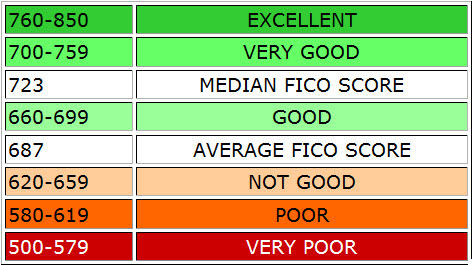
The FICO credit score model ranges from 300-850 with 850 being an excellent score and 300 being the worst score. The higher the credit score the lower the interest rate you will receive for a loan or line of credit. Possessing a good credit score can save you thousands of dollars in interest over the life of the loan or on a line of credit. A good credit score is generally in the range of 720 or above but may vary from lender to lender.

When applying for credit or a loan if all three credit scores are pulled, the middle score is generally the score used with the application.  Your credit score varies from each bureau because each agency collects their own data from various sources and may collect different data for the same account. Your score can vary anywhere from 5-40 points between the three credit bureaus.

Your credit score changes due to updates to your credit file which changes based on account activity such as balance changes or additions to your credit file (i.e. new accounts or deletion of older negative accounts more than 7 or 10 years old). As a result, you may see a difference in your score from one month to the next.  Here are some guidelines to help you determine how payments affect your credit score:


Payments

  • Paying a 30 day late payment can increase a score by 3-80
  • Paying collection accounts can increase a score by 20-90 points
  • Paying public records (judgments, tax liens, Chapter 7 or Chapter 13 bankruptcy) can increase a credit score by 75-150 points
  • Paying a charge-off can increase a credit score by 50-100 points
  • Paying a repossession can increase a credit score by 50-100 points
  • Paying delinquent student loans which can increase a credit score by 50-80 points


The major disadvantage of credit scoring is that it relies on information in your credit report that may contain errors. It is estimated that 75% of credit reports contain at least one error.  That is why it is so important that you check your credit report at least once a year to ensure that all information is accurate and up to date.  

If you plan on purchasing a large item such as a car, house or investment property, it is best to pull your credit yourself to see if any negative items appear so you can fix those issues before applying for a loan. The best way to understand your credit score is to do research and read the information that is included when you order your credit report.

Saturday, January 23, 2016

Get the Financial Help You Need Now


You go to see a dentist when you have a tooth problem, a doctor when you are sick, a mechanic when you car needs repair, a lawyer for legal advice, so why don't you hire a financial expert to help you with your finances? You can.  

Get the advice of a true, talented and passionate financial expert to help you blast away bad financial habits and achieve the life you always wanted. 

Using my financial programs you will have: 
  • Less stress
  • More options, more choices
  • Peace of mind
  • Access to products and services
  • Save money
  • Increased cash flow
  • Increased net worth

                   I have some great financial programs to help you with your finances! 
                                                 Take charge of your finances now.


Credit Score Mastery Program
If you have bad credit, I have a Credit Score Mastery Program. After completing this program clients: will feel better, will get easily approved for personal or business credit, will have negotiating power, increase job opportunities, will save money in fees, will increase liquidity, and have more options and more choices when spending money. I had a client who had a 420 credit score and I assisted them by increasing their credit score to 700. They were able to purchase a home and create financial stability for their family. If you want to have good credit click here to purchase this program now!

Identity Theft Program
If you have been a victim of identity theft, I have an Identity Theft Program. After completing this program clients: will feel better, get their identity back, save money in fees, save time, learn ways to protect their identity in the future. If you want to get your identity back click here to purchase this program now!

Budget Mastery Program
If you are living paycheck to paycheck, struggling to pay your bills or are overspending, I have a Budget Mastery Program. After completing this program clients: will learn how to track and categorize spending, differentiate between wants and needs, save money on purchases, and increase your monthly cash flow. If you want to be a better steward of your money click here to purchase this program now!
If you woud like more information feel free to contact me at consulting at hefreemanenterprises dot com.
I also create customized programs to fit your specific needs. Take action today. Don’t wait. Contact me at consulting at hefreemanenterprises dot com.

Kind regards,

Harrine Freeman

Owner, H.E. Freeman Enterprises
Financial Expert, Speaker, Freelance Writer
Author of How to Get Out of Debt: Get an "A" Credit Rating for Free
As seen in Forbes, MSN Money, Marketwatch, NASDAQ.com, Yahoo

Thursday, August 13, 2015

Want to Improve Your Finances Help Are Some Options to Help You


If you are experiencing financial challenges or would like to improve your finances here are three options to help you. Purchase all three or a combination of them.

Purchase a copy of my self-help financial audio CD's for less than $15 available on iTunes at https://itunes.apple.com/us/artist/harrine-freeman/id588170883?mt=11.

Purchase my best-selling self-help book for less than $15, How to Get Out of Debt: Get an "A" Credit Rating for Free on iTunes, Amazon, Kindle http://amzn.to/TKNlPl, Nook http://bit.ly/GzvFRk  and Barnes & Noble. 

Purchase my financial counseling services to help with debt, credit or budget/spending issues. For more information send an email to consulting at hefreemanenterprises dot com or call 301-280-5923.


Ask about my client referral program. Refer a client and get paid! For more information send an email to referral at hefreemanenterprises dot com or call 301-280-5923.


Sunday, October 26, 2014

Should You Use a Credit Repair Counseling Agency


Over one million people file for personal bankruptcy every year. Consumer debt is a huge problem in America today. As a result, many people don't know how they got in debt and don't know where to turn for help. Many people go to credit counseling agencies for assistance.

A credit counseling agency is defined as a company that advises you on managing your money and debt and helps you develop a budget as well as offers free workshops. Some credit agencies or credit repair companies may advise you on managing your money, restore your debt and may develop a budget (spending plan) for you.

When choosing any agency to assist with repairing your credit ask what services are provided based on what your needs are. If you are only concerned with restoring your credit then search for those types of companies. If you are looking for a full service company then look for credit counseling agencies or credit repair service companies.

However, I would use caution when hiring a credit counseling agency or credit repair service. Here are some red flags when considering working with a credit repair counseling agency or a credit repair company:

1. If a company provides guarantees that they can increase your credit score by a certain amount of points don't use them. They are no guarantees because information can be removed from your credit report and your credit score will increase but it depends on your credit score, the type of credit that was delinquent, your debt-to-income ratio and many other factors.

2. Check out the companies' website and check to see how long the company has been in business.

3. Check to see what fees are being charged. If you have to pay a registration or initial fee and then a monthly fee of X dollars that defeats the whole purpose of getting out of debt. You should either be charged a flat fee or monthly fee.

4. If you are already working with a credit repair counseling agency or credit repair company ask to see sample letters that will be sent to your creditors. If a company refuses to show you (which most probably will) then you have no idea what was stated in the letter. I give all of my clients companies of the letters I write to repair their credit.

5. Don't do business with a company that says they will use rapid credit scoring to repair your credit. This method jams the credit reporting agency system by sending many letters about the same issue for inaccurate and accurate information. The system gets confused and removes the items mentioned in the letter from the person's credit report. However, the credit reporting agencies do audits of their systems and eventually the items will be put back on your credit report.

6. Ask the company what is the process they use to restore your credit, if the company does not tell you then don't use them.