Tuesday, March 08, 2016

7 Smart Ways to Ensure You Are Paying the Right Creditor


Receivable / Accounts: Paid in Full -- Now What?              
Many consumers do not know that once a delinquent account is reported to a collection agency a consumer has a short amount of time to pay the bill.  This is because collection accounts are put on a nationwide registry and each collection agency in the country gets notified of a collection account.  However, only one collection agency has a legal right to collect money on a delinquent account.

It can be very difficult trying to make payments on a collection account because a collection agency holds a collection account for a few months, it they are unsuccessful in collecting on the debt owed the account is forwarded to another collection agency. This process continues until the account is paid or legal action is taken against the consumer. 

Collection agencies don't want you to know that as a consumer you have a legal right to question the validity of a collection agency which is called debt validation.  Many consumers have paid money on delinquent accounts to a particular company only to find out that the company did not legally have a right to collect money on that account.  As a result the consumer still owed the money on the delinquent account. To prevent this from happening to you, here are 7 ways to validate a debt and ensure you are paying the right creditor or collection agency:

  1. Request the creditor, collection agency or attorney to provide documentation that the company is authorized to collect on the debt. Ensure the name and address of the collection agency appears on the documentation which should be on company letterhead.
  2. Ask for proof of the total amount of the debt including payment history from with the original creditor and status of the account. Verify the documentation against your own records.
  3. Request the collection agency to provide the original contract or other documentation showing the agreement you made with the original creditor including the name and address of the original creditor.
  4. Ask the creditor to provide a copy of their business license to prove they are licensed in their state to collect money on delinquent accounts. However this varies from state to state.
  5. If the creditor use profanity, harasses you, is rude or threatens you inform the collection agency that they are subject to the Fair Credit Reporting Act (FCRA), they might argue and say they are not but they are considered debt collectors and are covered under the act.
  6. If the creditor cannot verify the debt they cannot collect any money owed on your account and is not allowed to contact you about the debt.  They also cannot report the account on your credit report.
  7. A creditor may respond to your debt validation letter by sending you a summons to appear in court. This is a scare tactic and is illegal.  A creditor has to validate the debt before they can file suit against you.

Keep records of all documentation you receive and all documentation you mail.  Send all documentation via certified mail with return receipt.  If you find that the creditor or collection agency is violating the FCRA you can file a complaint with your local small claims court, notify the credit bureaus and file complaint with the Federal Trade Commission, www.ftc.gov.

Friday, March 04, 2016

March Madness and Your Finances


March Madness is always action packed and full of surprises. Everyone will be watching to see what teams are selected to play and the teams that advance to each round. With all this excitement about March Madness, consumers should use that same excitement to improve their financial situation. 

Some consumers go into debt watching March Madness: ordering cable sports packages, hosting game parties, going to sports bars to eat, drink and watch the games all day, buying tickets to live games, and buying sports memorabilia. All of these costs can add up and cause you to overspend.
The goal of basketball is getting the ball to go securely in the net to score points. 

The goal of improving your financial situation is getting out of debt, increasing your credit score and your liquidity.  If you are obsessed with watching March Madness you may be obsessed other things. This year use that obsession towards your finances. Use your tax refund to improve your financial situation. If you are spending more than you earn, living paycheck to paycheck or have little to no savings or retirement, here are 6 ways to improve your financial situation. 

  1. Don’t hit an air ball – Many people file bankruptcy multiple times as an easy way to get out of debt. You should only file bankruptcy as a last resort. Filing for bankruptcy greatly lowers your credit score and remains on your credit report for 7-10 years.
  2. Ball control – Manage your finances by reducing expenses and reducing debt. Taking control of your finances is key to developing good spending habits and reducing the change of having a financial crisis. The total amount of debt you owe contributes to 35% of your credit score.
  3. Shoot for a basket – Set financial goals as part of your budget. Develop an action plan to achieve each goal. Creating a budget helps you live below your means, reducing your spending and reduces your chances of going into debt. Your total monthly debt excluding mortgage and car loan should be no more than 10% of your total monthly gross income. 
  4. Don’t try to achieve a bury – A credit score or FICO score ranges from 300-850. Only a small percentage of Americans, less than 5% achieve a score in the 800’s. Focus on paying down debt, paying your bills on time and getting current on any late accounts. These actions will help increase your credit score. Don’t focus on getting a perfect credit score, focus on getting the best credit score you can.
  5. Don’t stay cold – Many consumers have tried different methods on their own to get out of debt. If you are unable to improve your situation on your own, don’t stay cold – get professional help from a credit counselor, financial coach or financial planner.
  6. Avoid disqualification – You can lose your job or get disqualified from a job by having bad credit. Bad credit can also prevent you from being approved for a loan or line or credit.

Monday, February 29, 2016

How Credit Score Points Affect Your Credit


Your credit score it is one of the most critical factors in your financial life. Your credit score determines if you are approved for a loan or line of credit. Credit scores are used to determine: if you will be hired for a job, interest rates, terms and conditions, downpayment costs, rates for medical and other insurance coverage, approval for cable and internet service and more.

A credit score is a mathematically calculated number developed by the Fair Isaac Corporation (FICO) that lenders use to rate potential customers in determining the likelihood that a customer will pay their bills on time.

A credit score or credit rating is determined by using five main criteria as defined by MyFico.com: your payment history which accounts for 35% of your credit score, the amounts owed which accounts for 30% of your credit score, the length of your credit history which accounts for 15% of your credit score, new credit which accounts for 10% of your credit score, and the types of credit used which accounts for 10% of your credit score.

Payment history shows the history of how you paid your bills either on time or late. Amounts owed shows the total amount of credit you have available. The length of history indicates how long you have had credit. New credit indicates how many times you have applied for new credit. If you open too many new accounts in a short period of time this may lower your credit score. The types of credit used indicate the types of accounts you have such as revolving or installment accounts. Revolving accounts are usually credit cards and installment accounts are usually mortgages, auto loans, etc.

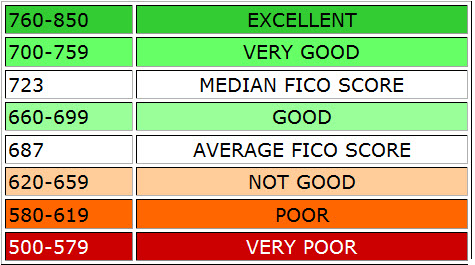
The FICO credit score model ranges from 300-850 with 850 being an excellent score and 300 being the worst score. The higher the credit score the lower the interest rate you will receive for a loan or line of credit. Possessing a good credit score can save you thousands of dollars in interest over the life of the loan or on a line of credit. A good credit score is generally in the range of 720 or above but may vary from lender to lender.

When applying for credit or a loan if all three credit scores are pulled, the middle score is generally the score used with the application.  Your credit score varies from each bureau because each agency collects their own data from various sources and may collect different data for the same account. Your score can vary anywhere from 5-40 points between the three credit bureaus.

Your credit score changes due to updates to your credit file which changes based on account activity such as balance changes or additions to your credit file (i.e. new accounts or deletion of older negative accounts more than 7 or 10 years old). As a result, you may see a difference in your score from one month to the next.  Here are some guidelines to help you determine how payments affect your credit score:


Payments

  • Paying a 30 day late payment can increase a score by 3-80
  • Paying collection accounts can increase a score by 20-90 points
  • Paying public records (judgments, tax liens, Chapter 7 or Chapter 13 bankruptcy) can increase a credit score by 75-150 points
  • Paying a charge-off can increase a credit score by 50-100 points
  • Paying a repossession can increase a credit score by 50-100 points
  • Paying delinquent student loans which can increase a credit score by 50-80 points


The major disadvantage of credit scoring is that it relies on information in your credit report that may contain errors. It is estimated that 75% of credit reports contain at least one error.  That is why it is so important that you check your credit report at least once a year to ensure that all information is accurate and up to date.  

If you plan on purchasing a large item such as a car, house or investment property, it is best to pull your credit yourself to see if any negative items appear so you can fix those issues before applying for a loan. The best way to understand your credit score is to do research and read the information that is included when you order your credit report.